CHARLIE OUTHWAITE
  • Home
  • About
  • Publications
  • Contact
  • Blog
  • Documents

Standing out in the crowd, part 2:  Applying for post doc positions

3/10/2016

38 Comments

 
​This is my second post containing information from an early careers mentoring event that I attended not too long ago.  This event was run by the BES Macroecology SIG and provided a safe space to ask experience mentors for advice.  One session on applying for post docs led by Prof Andy Purvis was full of useful information so here is my summary of what we talked about…
 
Finding a post doc 
Before you start looking for positions, you might want to stop and think about what kind of options are acceptable for you.  After all, this will be a major part of your life and it is important that you consider what you want to get out of a position and how it could impact your quality of life. Think about what you would like to work on and what you would hate.  You might be qualified to carry out a certain position but really don’t want to do it.  Just because you can do something, that doesn’t mean you should!  Think about what the red lines would be that you don’t want to cross in terms of where you want to work, doing what and with who.  
​
There are two main courses of action for getting your next position in academia: make it happen yourself by writing a grant, or apply to an advertised position.

  • Make it happen
One option is to make your own position.  If you have an idea on what you want to work on and who you could work with, you might think about applying for a grant to fund your research.    You could approach a person or a department you want to be a part of and discuss collaborating on a grant proposal.  Inviting someone to give a seminar is a great way to start a conversation about potential ideas.  Researchers are often looking for ways to bring funding into their lab, and if you are offering to do most of the work in preparing the proposal, what’s not to love!

  • Find an advertised position
When looking for a post doc, make sure to let people know that you are looking and roughly what you are looking for.  This will help to ensure adverts will come your way when people see them.  Positions are advertised in a number of places but ensuring you are subscribed to relevant mailing lists will help to keep you in the loop and reduce the need to trawl the internet.  Twitter can also be useful for this.  Although I haven’t found a specific hashtag that is regularly used to promote post doc positions, if you are following relevant people you should pick up anything from them that would interest you.  Special interest group social media pages should also flag up things in your area of research.
 
Applying for the post doc 
If you can afford to, spend time tailoring each application to the job you are applying for.  Use your CV to target specific points in the person specification, rather than simply sending the same bog standard CV for all applications.  This will help push you to the front of the pile.  Take each point in the person specification and try to include information on a relevant skill or experience that meets that point.  This can be in your CV or in the accompanying cover letter.  If you don’t meet one of the points in the specification, show enthusiasm and willingness to learn about that element.  CVs are usually sorted using a points based system focused on how many of the desired criteria that you meet.  However, don’t feel that you have to restrict yourself to these points.  If you can see alternative skill sets that are particularly relevant to the project that have not been considered in the application, share your thoughts and ideas.  This will show that you understand what is required from the project and have thought about other aspects that you can bring to the table.  Finally, when you have been working as part of a close group, it is easy to forget that you have very specific skills, particularly when other people in your group also have these skills and are working on similar things to you.  Remember, that outside of your group, those shared skills may be quite rare.  So don’t forget about them or assume that many people can do what you do.   See my previous blog post on writing academic CVs for more information.
 
Interviews
Interviews are tough.  They are stressful and there is a lot of pressure, particularly on how to respond when you don’t know the answer to a question.  The key thing here is to try to maintain your composure (even if you are the total opposite on the inside!). 

You will often be asked to give a short presentation.  This should be different to the kinds of talks you give at conferences. Instead of trying to show how you were able to do this new and exciting thing, you are trying to show how doing this new and exciting thing has provided you with skills that are relevant to the new project.

Prepare for the questions that you know are going to come up, this way they won’t catch you by surprise.  The usual suspects are:

  • What work have you been doing up to now?
  • Why do you want the job?
  • How are your skills suited to the position?
  • What do you want to do next?
  • Etc. etc.

Then when the unknown questions come up, you should be a little less flustered after being able to provide thought out answers for the usual ones.  If you are unsure of the meaning of a question or would like some clarification, ask!  Take time in answering your questions, don’t be afraid to take a minute to compose your thoughts.  Take a drink of water in with you and take a sip if you need something to stop you from blurting out the first thing that comes into your head.  If you can, think about how you can round off or summarise a point.  This makes is obvious when you have finished answering a question and prevents your responses from trailing off.  Mock interviews can be very useful for practising these sorts of skills.  Universities often offer sessions where you can take part in mock interviews, otherwise ask the people that you work with to help you.  You do not want your first interview to be the time when you figure out which areas you need to improve on.
 
Well I hope this compilation of advice has been useful! I can take no credit for the content but I learnt a lot and thought it would be best to share!  If you ever get the chance to go to one of these events, I can highly recommend it.
38 Comments

Standing out in the crowd, part 1: Preparing an academic CV

30/9/2016

36 Comments

 
A couple of weeks ago, I went to an early careers mentoring event that was run by the BES macroecology SIG.  It was a fantastic event, providing an environment for early career researchers to discuss topics with experienced mentors.  It was so useful and I found myself writing pages and pages of notes in an attempt to ingrain the advice in my brain.  I realised that many people in a similar position to myself might also feel lacking in knowledge on these areas and so I have compiled my notes into two blogs focussing on the topics which I found most useful: academic CV writing and applying for post docs.  This is the first of these two posts.
 
It is said that it is currently much harder for students to get a job in academia than ever before.  Although there are more jobs out there, there are also many more people applying for them.  Getting your CV right is clearly an important factor in getting that coveted job; giving yourself the greatest chance of getting through the mass of applicants to that all important interview stage.  The first session I sat in on was a discussion group on writing CVs lead by Prof Andy Purvis of the Natural History Museum.  So here is what I found out…

Broad or specialised skills set?
First, we discussed whether it is best to be specialised or more broad in your skills set when applying for jobs and writing your CV.  We were advised that at the start of an academic career it is best to be more specific in your area of expertise; have a recognisable identity and try to be the “go-to” person for your subject area.  It is best to be a specialist at the earlier stages of your career and to broaden those skills and areas of interest as you progress.  So, as a PhD student applying for a post doc, it is advised that you highlight your area of expertise within a large portion of your CV.

What to include in your CV?
When applying for jobs, the main aim of your CV is to get you through the sift panel – to make sure that you stand out from the many, many applications from people, just like you, who are also applying for the job.  There will usually be a points based scoring system to see how well an applicant meets the person specifications of the job.  Two elements to get you through the panel are making sure you include some “hooks” in your CV and tailoring the CV to the job.

Hooks:
Hooks are elements on your CV that are being looked for and will make you stand out from the crowd.  Here are a list of examples; you do not need to try and include all of them but working towards some of these is something to think about during your PhD.
  • Presenting at conferences and meetings ­– there are conferences large and small out there with options to present posters or give talks.  It all helps to get your name out there and gives you practise at communicating your work to wider audiences.
  • Publications – an obvious one perhaps but publications of all kinds can help give your CV a boost with papers being the best option.
  • Getting funding­ – successfully applying for money from a competitive source is a great CV booster.  Travel grants or small grant schemes are a great source as well as money from special interest groups for a workshop or meeting.
  • Peer review papers – concentrate on the journals you want to publish in and put this down on your CV.  Working on reviews with your supervisor or others is a great way to start out.
  • Spend time in another lab – getting experience of working with people other than your supervisor is a useful addition to any CV.  You probably don’t want to be seen as a mini-me of your supervisor!
  • Writing ­– writing commentary pieces or review articles are a great addition.  Blogs are an easy way to practise writing for a wider audience too.
  • Contribute to working groups or synthesis groups – being a part of something outside of your own project will show independence and interest in collaboration.
  • Other prior experience – only the relevant parts!  Don’t fill out your CV with information that is not relevant to the job you are applying for.
Finally, an important thing to remember when compiling your CV is: don’t be afraid of white space.  You don’t need to fill every inch of the page.

Tailor your CV to the job:
​
It may be tempting, especially if you are applying for a lot of positions, to cram as much as possible into your CV and send the same one off with all applications.  However, if you have the time to spare, spend it tailoring your CV to the job you are applying for.  It will be beneficial in the long run!  Although you may have pages and pages filled with all the different experiences and skills you have, a CV should only be maximum 2 pages long.  So that means being ruthless and cutting it all down.  The best way to go about this is to reverse engineer the job advert.  Take each point in the person specification and try to include the relevant skills and experience in your CV.  You can go into more depth in your covering letter, using the person specification and your chosen experiences to show exactly how you meet the requirements.  The covering letter is also a great place to include information on other skills you have and particularly how these are relevant for the project you are applying for.  What are they missing that you can provide?
Well, I hope that was useful.  Keep an eye out for my second post with information on applying for post docs.
36 Comments

BES 2015 conference poster

3/2/2016

1 Comment

 
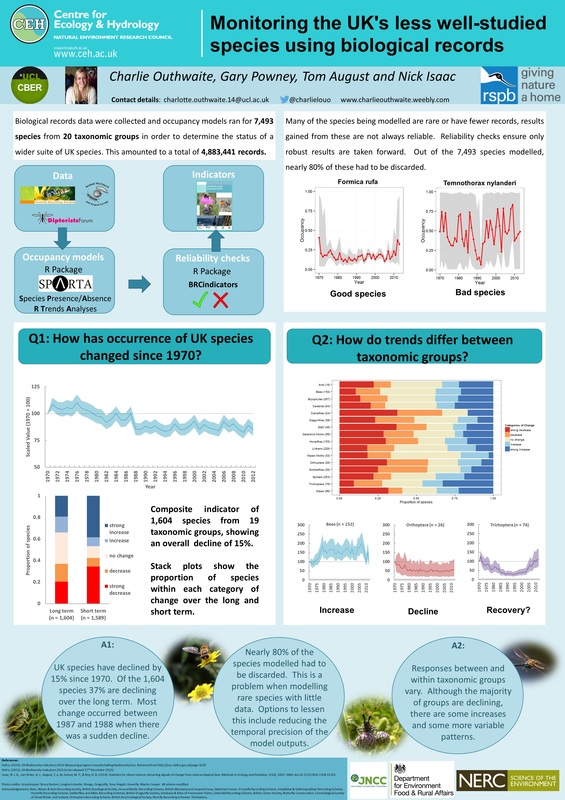
As my poster was awarded the runner up prize at the recent BES conference in Edinburgh, I thought I would share it on here.

The poster summarises some of the work I have been undertaking during the first part of my PhD.

To summarise; I have combined the use of Bayesian occupancy models and biological records data from recording schemes and societies to assess how species occurrence has changed since 1970.    I collected data and ran models for nearly 7,500 species from 20 taxonomic groups focussing on less well-studied species.
Picture
1 Comment

A blog about a blog - guest blogging

24/7/2015

0 Comments

 
Since writing my previous blog post 'the importance of being open', I was asked to write a guest blog for the DNA Digest website and newsletter.   DNA Digest is a non-profit organisation that aims to promote the secure sharing of genomics data for research.  I was given the briefing to "try to somehow generalise the data sharing problems in scientific research and base it on your own experience in ecology".  Although I was excited to have the opportunity to produce a piece of writing and have that shared with a wider audience than my twitter account can reach, I was also quite nervous.  Surely there was someone better for the job than a first year PhD student with only a few years of exposure to the realm of scientific research, how much did I really know about the topic?  I will be honest and say that I wrote and rewrote the piece way too many times and worried about it constantly for a good couple of weeks.  But in the end, with a bit of Googling and reading around I was able to produce something that I didn't think was completely wrong, especially after a nudge from my supervisor to just stop and send it off.  And I am glad I did!
  
As an experience, it was a good one.  I was able to write a piece, directed at an audience that was wider than the ecological community, work on being concise and learn a little more about an issue not only within my own field but one that is prevalent in others too.  I have also learnt not to worry too much about what other people will think, that shouldn't be a barrier to learning.  Researching a topic and writing about it is a great way to learn and knowing that you or someone else will post the finished product forces you to get it done.   

So, don't let the nerves get the better of you!  I would encourage anyone to try and write a short piece on something they feel they know little about, you soon realise you know more than you think and it encourages you to research the area so as not to say something completely wrong!  If you aren't going to post it somewhere yourself, find somewhere else to put it; perhaps your department has a blog.  You never know who could read it and what other opportunities could arise from that small piece of work.

If you are interested in seeing my post, it can be found on the DNA Digest website here.
0 Comments

The importance of being open

14/5/2015

0 Comments

 
Having recently been exposed to the idea of open data and being relatively new in the research world, I personally believe that openness is a great concept.  It encourages reproducibility, ensures data isn’t lost over time and exposes new areas of research and collaboration.  However, I think the major barrier to openness becoming commonplace, especially in the field of ecology, is the amount you have to learn in order to become fully open and reproducible.

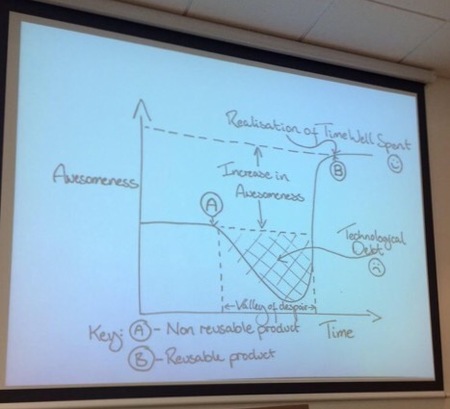
The massive learning curve ahead is certainly daunting.  As a first year PhD student, I already feel like I have a heap to learn and adding more things to the list does not feel particularly encouraging.  Norman Morrison (University of Manchester) presented a great slide illustrating this point at the recent workshop on “open data and reproducibility: the good scientist in the open science era” run by the BES Macroecology SIG and Methods in Ecology and Evolution:

Picture

His amazing figure shows the journey someone like me has to go through to reach peak awesomeness in terms being fully open and reproducible with their work. Clearly the part I, and others like me, dread the most is the “valley of despair”.  This massive drop in awesomeness is where we are stuck with a technological debt of knowledge in how to be reproducible.  Although the end point of having a reusable product and the realisation of time well spent (point B/smiley face) seems like a great place to be, is it really worth all that time and effort? 

Well, one portion of the meeting was dedicated to showing us just how easy it is to become more reproducible and the ease with which we can ensure our data is openly available.  One great option is publishing data within data journals.  These journals are providing a platform to make data available whilst being able to give credit to those who collected it.  They are often linked with repositories so that you are also making the data easy to access for others who might wish to use it.  The repositories themselves offer long-term storage and accessibility of data and there are many options available for different data types.  Those commonly used for ecological data include GBIF, figshare, Dryad and the NERC data centres.  A range of software options were also introduced including; ISA-Tab for storing metadata information alongside data, the R package knitr for producing clear and reproducible code and the Zoön software for performing reproducible species distribution models.  I had a go at using knitr as part of the Reproducible Research online course available through Coursera.  It is a really easy way to integrate text and R code to produce an annotated report-like piece whilst being able to produce outputs and plots as you go along.  It makes reading through code a lot easier than navigating through a set of hashed comments!

I don’t know about anyone else but I will certainly be looking into some of the options presented at the workshop and will attempt to take that leap into the valley of despair!  I do hope, however, that these tools and methods are incorporated into university programs in the future.  If we want the field of ecology to be open and reproducible we need to get people working in this way from the very start of their career.  I know I am certainly wishing I had started to learn all of this during my undergrad!  Let’s hope this starts soon so that others do not have to go through such a dramatic drop in awesomeness to reach that smiley face at the end.

0 Comments

Write about Research

7/5/2015

0 Comments

 
This blog received the runner up prize in the Write about Research competition in the Genetics, Evolution and Environment department at UCL.  This competition encouraged students and postdocs in the department to write about their work.  It will be posted on the GEE blog some time this year.  Keep an eye out for the winner and other entries here.

It is a little long but offers a background to my area of work.

The challenge of monitoring biodiversity.

Biodiversity, is a complex term encompassing the variety of life found on Earth. It incorporates not only differences between species but within species themselves and of the environments and ecosystems where they are found. We as humans benefit a great deal from the biodiversity on earth in a range of ways; from the clean air we breathe to food, materials and medicines that are produced as a result. These products or services are known as ecosystem services and these services depend on biodiversity. Monitoring the status of biodiversity is therefore an important area of research, but offers its own challenges. New methods offer the chance to utilise data that has been underused in the past due to its associated biases and we are now able to explore and monitor the responses of biodiversity over time for many more species than has previously been possible. This has opened the door not only to more knowledge on a greater range of species but also allows us to look into what aspects are influencing these changes, such as the impact of climate change.

In April 1992, an agreement was signed by a number of government parties to the Convention on Biological Diversity (CBD) agreeing to the global target “to achieve by 2010 a significant reduction of the current rate of biodiversity loss”. Unfortunately, this target was never achieved and so, in 2010 an updated plan was established at the tenth meeting of the Convention in Nagoya, Japan. This revised plan includes 20 main targets, known as the Aichi Biodiversity targets, under 5 strategic goals each encompassing one aspect to benefit biodiversity.

In order to measure progress towards these targets, at both a national and a global scale, a number of indicators of change have been developed, these are often simple graphs showing increases or decreases in the variable being monitored. For the UK, these are published annually by DEFRA (the Department for Environment, Food and Rural Affairs) in the Biodiversity Indicators in your Pocket report (DEFRA 2014). Indicators are composite measures of change and are a simple and easy way to communicate change over time. The most recent BIYP report includes a suite of indicators aimed to report on UK progress towards the Aichi targets. These range from indicators of change in volunteer time spent in conservation organisations to assess progress towards strategic goal A (Address the underlying causes of biodiversity loss by mainstreaming biodiversity across government and society) to indicators of the status of UK priority species for Strategic Goal C (To improve the status of biodiversity by safeguarding ecosystems, species and genetic diversity).

However, the monitoring of aspects of the goals is not simple and biodiversity itself provides a great challenge. Take target 12 for example; “By 2020 the extinction of known threatened species has been prevented and their conservation status, particularly of those most in decline, has been improved and sustained”. In order to assess whether the decline and extinction of threatened species has been prevented we need to be able to measure how many there are in the first place, and how that changes over time. Ideally, we would like to go out and count exactly how many there are of each species, but of course this is not possible. It would be difficult enough going out and counting every species in your own garden, let alone across the whole country. So, we have to use the next best alternative. In some cases, standardised monitoring schemes such as the Breeding Bird Survey are set up and species numbers are monitored using standardised techniques across specific sites. This data can then be used to accurately estimate the abundance of those species observed. However, this kind of data is costly to collect and requires a lot of time and effort and so, is not available for the majority of species.

An alternative form of data is biological records. Biological records are a data type that is high in quantity but has a number problems associated with it. Often collected by volunteers through citizen science projects, this type of data can be highly variable in its level of accuracy and completeness. However, with interest and participation in citizen science increasing, the amount of biological records data available is rising. With so much data on hand, and often for those groups of species that are less well studied (such as insects) and for which monitoring scheme data is unavailable, it is important that these data are put to good use. However, because of the problems associated with this data type, it is underused and under-appreciated. The main problem is that it is collected in an unstandardised way, which introduces bias into the data. Records will often be collected by an individual at a location of their choosing and they may not report every species they see.

A number of robust statistical methods have been developed that are able to account for these associated biases. Bayesian occupancy models are a complex statistical technique which has been shown by Isaac et al (2014) to most effectively account for the biases of this type of data and produce reliable indicators of change. It is now being used to monitor changes in the biodiversity of less well studied groups of species using biological records from various recording schemes. For these species groups, this kind of data is all that is available and so employing these new methods for analysing biological records is enabling greater research into areas where little is currently known.

However, with human induced drivers being the biggest threat to biodiversity loss, it is not enough to simply monitor changes in species trends. There is a growing need to understand what is causing these trends and how a species’ traits can increase its susceptibility towards these drivers. Through a more thorough understanding of the effects drivers such as climate change have on a group of species, and which species within that group will be most affected, it would be possible to design conservation interventions to target those species most at risk, preventing future declines. This process could act as a form of triage, in determining those species that will be most affected so that conservation and policy action can be targeted to those areas in the first instance. This is becoming increasingly urgent as a mid-term report on progress towards meeting the CBD 2020 targets by Tittensor et al (2014) indicates that progress is not positive.


References

Defra. (2014). UK Biodiversity Indicators 2014: Measuring progress towards halting biodiversity loss. Retrieved from http://jncc.defra.gov.uk/page-4229

Isaac, N. J. B., van Strien, A. J., August, T. A., de Zeeuw, M. P., & Roy, D. B. (2014). Statistics for citizen science: extracting signals of change from noisy ecological data. Methods in Ecology and Evolution, n/a–n/a. doi:10.1111/2041-210X.12254

Tittensor, D. P., Walpole, M., Hill, S. L. L., Boyce, D. G., Britten, G. L., Burgess, N. D., … Parks, B. C. (2014). A mid-term analysis of progress toward international biodiversity targets, (October), 1–8.
0 Comments

Newbie Blogger

7/5/2015

25 Comments

 
I have decided to jump on the blogging bandwagon!  

Although the thought of people actually reading any of my posts is terrifying, I have been encouraged by my supervisor to get writing.  My main aim for this blog is to share experiences and advice with PhD students and others in a similar situation to myself.  It would therefore be great to hear your thoughts on the subjects discussed.  So, go forth and comment (if there is anybody out there other than my parents...)!

Wish me luck!

Charlie


25 Comments

    Archives

    October 2016
    September 2016
    February 2016
    July 2015
    May 2015

    Categories

    All
    ECR
    My Work

    RSS Feed

Powered by Create your own unique website with customizable templates.